Mass Expulsions in South Africa: A Modern-Day Pogrom?
MIGRANTS CRISIS
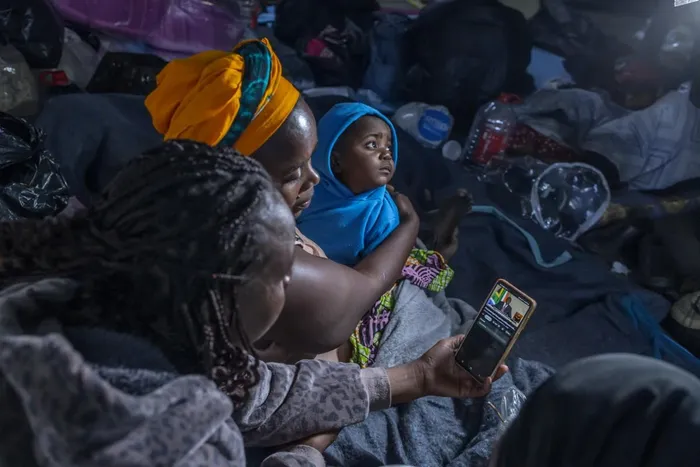
Foreign nationals camped outside the Department of Home Affairs offices in Durban on 7 June, 2026 use their mobile phones to watch South African President Cyril Ramaphosa addressing the Nation on its immigration crisis. Anti-migrant incidents display typical pogrom features: mob violence, vigilantism, deaths, vandalism, displacement, mobilisation, and inflammatory rhetoric, says the writer.
Image: AFP
Eddy Maloka
If there is one report an African country does not want to feature in, it is to find itself on the list of countries of interest of the African Commission on Human and Peoples’ Rights (ACHPR).
When a policy meeting of the African Union reaches this agenda item, some ambassadors use the time to take a smoke break, knowing they have nothing to worry about. The same cannot be said for a country whose name regularly appears in the ACHPR report. This is a stressful time for them. Some act proactively and raise their flag in anticipation of requesting to speak even before the floor is opened for discussion.
No one ever knows if South Africa will one day end up in the ACHPR report, in the league of bad actors in the African Union state system. But there is one place in world history where South Africa’s name will be inscribed: in the list of countries where mass expulsions of people and pogroms occurred.
We are now in the league of 15th-century Spain, which experienced expulsions of Jews and Muslims, 17th-century France where multitudes of the Calvinist Protestants were forced to leave their country, and the Russian Empire, still remembered to this day for pogroms committed against Jews there.
South Africa has experienced anti-migrant waves before, but this 2026 incident is unique.
There have been at least three prior events, including the 2008 violence in Alexander, Johannesburg, which caused 60 deaths, and the 2015 surge that affected Durban and Johannesburg, leading to the creation of a Special Reference Group on Migration and Community Integration. The third wave occurred between 2019 and 2021, characterised by a series of attacks, shop lootings targeting foreigners, and the rise of more organised, politically sophisticated anti-migrant campaigns.
The recent wave involved marches in Johannesburg, Pretoria, and Durban triggered by an unofficial June 30 deadline set by some civil society groups for undocumented migrants to leave the country. Whereas earlier waves were mostly spontaneous, recent anti-migrant activities have become more organised, led by political groups and determined non-state formations.
At least eight African countries – Nigeria, Ghana, Kenya, Mozambique, Malawi, Zimbabwe, Uganda, and Ethiopia – actively repatriated their citizens from South Africa, using chartered aircraft and fleet buses, ahead of the June 30 deadline, as part of a mass displacement involving over 25,000 foreign nationals.
There is already a debate about whether the 30th June was a success. To the organisers of the event, the thousands who responded to their call on the day and the geographic spread of their marches across the country are evidence of the event’s success. Some see the absence of expected violence as a positive sign and a disappointment for those who intended to exploit the day to destabilise the country.
But what about the victims?
The marchers have faces and leaders who are treated as celebrities in the media. So do their victims. These victims are more than images we see from a distance. We see crowds gathered at designated assembly points for repatriation, with luggage piled on top of one another, and mothers carrying their babies on their backs. They appear to us as an amorphous mass, faceless, as people without names. They are just a number – maybe hundreds, maybe a few thousand.
Yet, they have faces; they have names given to them by loved ones. They are like us – they have egos, they can feel pain, they have tears, and their skin is not made of stone but soft and vulnerable, just like ours.
The suffering of the victims began days before the 30th of June. First, in circumstances that forced them to leave their homes, then in the physical and psychological torture during their state of homelessness and wandering the streets of South Africa, and finally, in the ordeal they will face on their journey back home.
In its report, “Thousands of foreign nationals leave South Africa ahead of June 30 ‘deadline’,” France24 spoke to Congolese refugee Marjolain Mabako in KwaZulu-Natal. He has lived legally in South Africa for over 22 years. Mabako described how protesters entered their homes and threatened residents, forcing many to abandon their belongings and flee.
He recounted, “People have abandoned their homes,” and shared that he cannot return to his home or work. Mabako, a proud barber, said protesters ransacked homes and workplaces, stealing and beating people. He noted that on the day of the visit, a foreign national was assaulted and injured at the local market.
BBC's “They came with machetes – deadline looms for migrants to leave South Africa,” shared a Malawian woman’s experience: “I am very scared and traumatised,” said Esnat Joseph, 36, as she comforted her crying triplets. She fled her home in an informal settlement in Durban, KwaZulu-Natal, seeking safety in an open field where roughly 7,000 foreigners, mostly Malawians, had gathered with their belongings two weeks earlier.
“People came to my house and told me: ‘You must leave. We don’t want you here anymore, so go back to your country.’ There were 10 of them, armed with weapons,” she recalled, describing how South African men brandished machetes and whips. “They struck my husband on his head and neck, holding him as if to kill him. Thankfully, he survived because of God, but he’s now in the hospital.”
The Guardian’s story (“‘They will attack me if I stay’: immigrants in South Africa flee for safety amid violence and anti-foreigner protests”) about Jackson Makungwa details his struggle as a Malawian in South Africa. He carried only two small bags after 10 years there, unable to renew his work permit for two years. He expressed frustration, saying, ‘It’s not like I want to be illegally in the country, but the system doesn’t allow me to be here legally.’
He initially resisted leaving despite his mother’s pleas, but after a friend was attacked, he decided to go, fearing violence. Makungwa showed a photo of his two-month-old son, born to a South African mother, whom he couldn’t take with him due to missing travel documents.
Similar victim accounts can also be found in Al Jazeera’s “Migrants in South Africa fear violence ahead of June 30 deadline”, where we hear the voice of Esnat Joseph, a Malawian immigrant in Durban: “I am very scared and traumatised,” describing how attackers “came to my house and told me: ‘You must leave.’”
These anti-migrant incidents display typical pogrom features: mob violence, vigilantism, deaths, vandalism, displacement, mobilisation, and inflammatory rhetoric. This pogrom is still ongoing as I write this article in July. Many of its internally displaced victims have nowhere to go; some are arriving in the hundreds at embassies, which have become makeshift refugee centres.
I understand one female victim gave birth at a diplomatic facility. No food, no ablution facilities; affected embassies are overwhelmed, and the cold front of this winter is unrelenting. The marchers are back in the comfort of their homes, unaware of the suffering they have caused fellow human beings.
When this is behind us, hoping this will happen soon, we will pick up the pieces. There will be no marchers when the government alone approaches our neighbours and countries beyond to repair fractured bilateral relations.
Victims will be worse off. Besides their life left behind in South Africa, assets lost, bones broken and scars they suffered in their exodus back to their respective homelands, they will have a new battle back home. They will have to rebuild their lives, re-cultivate social networks dormant all these years. The hardest and most painful part will be transitioning psychologically into a new reality. Whether they will make peace with how they were treated, we leave that to time.
Scenes our country has recently seen evoke three key moments in history. The first is in Spain, on 31 March 1492, when King Ferdinand and Queen Isabella issued the notorious Alhambra Decree, giving Jews until 31 July 1492 to either convert to Catholicism under duress or face expulsion. The tragedy that ensued led to mass dispersal and a diaspora known today as the Sephardic Jews.
Second, in France in October 1685, Louis XIV issued the Edict of Fontainebleau, which outlawed Protestantism in France, ordered the destruction of Huguenot churches, closed Protestant schools, and gave pastors a mere two weeks to convert or leave the country. Many victims of this persecution ended up in South Africa in 1688 as French Huguenots who settled in present-day Franschhoek and introduced winemaking to our country.
Thirdly, in colonial South Africa. The aftermath of the notorious Natives Land Act of 1913 is one example. The law prohibited black South Africans from buying, leasing, or occupying land outside designated areas, leading to thousands of families being abruptly evicted from white-owned farms.
Sol Plaatje documented the human toll of these evictions in his 1916 book, Native Life in South Africa, famously stating: “Awaking on Friday morning, June 20, 1913, the South African Native found himself, not actually a slave, but a pariah in the land of his birth.” Plaatje described how victims wandered public roads with their belongings, much like the Congolese and Malawians mentioned earlier.
It is unclear whether it is accidental that the Zulu word “Abahambe” (“they must go”), which has become a political slogan for this anti-migrant campaign, rhymes with Spain’s “Alhambra”. However, we must document this human suffering as Plaatje did in 1913 to assist our nation when the moment of reckoning inevitably arrives for the necessary soul-searching.
* Eddy Maloka is Professor at the Wits School of Governance. He writes in his personal capacity.
** The views expressed do not necessarily reflect the views of IOL or Independent Media.