Path to Fixing Crime Intelligence Rot is Fraught with Complexities
SAPS TURMOIL
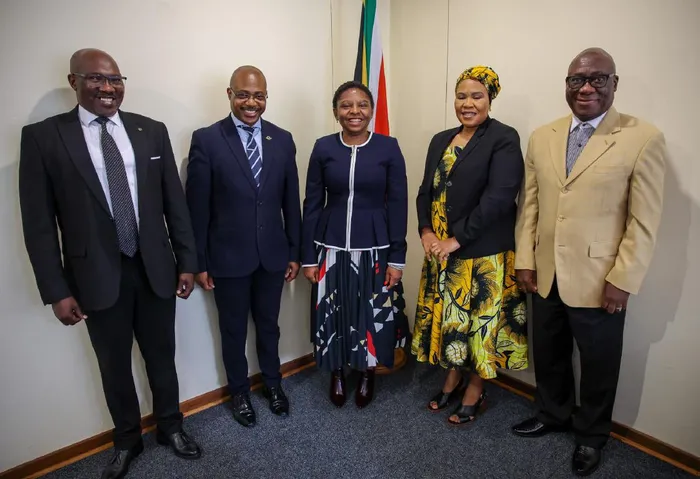
FROM LEFT: Lt-Gen Dumisani Khumalo (Head of Crime Intelligence), Dr Ntandazo Sifolo (Acting Co-ordinator for Intelligence), Minister in the Presidency Khumbudzo Ntshavheni, Lt-Gen Thalita Mxakato (Chief of Defence Intelligence), and Ambassador Tony ‘Gab’ Msimanga (Acting DG of the State Security Agency) at the launch of the National Centre for Intelligence Co-ordination (NCIC), in Pretoria, on April 14.
Image: GCIS
Dr. Reneva Fourie
One year has passed since KwaZulu-Natal Police Commissioner Lieutenant General Nhlanhla Mkhwanazi delivered explosive allegations about links between organised crime and elements of South Africa's criminal justice system.
His testimony reinforced a pattern that has surfaced repeatedly through commissions of inquiry, expert panels and judicial investigations over many years. At the centre of that pattern stands Crime Intelligence, a division that remains essential to combating organised crime, but which has repeatedly been identified as vulnerable to corruption, manipulation and criminal infiltration.
Crime Intelligence performs legitimate and valuable anti-crime functions, and several of its members are hardworking and honest. The division occupies a uniquely sensitive position within the South African Police Service.
Its mandate provides access to covert operations, intelligence gathering, surveillance capabilities, confidential informants and secret expenditure. Those powers are indispensable for dismantling sophisticated criminal networks.
However, they also make it an attractive target for organised crime seeking to weaken law enforcement from within. Numerous official inquiries have identified this vulnerability and have warned that the consequences extend far beyond individual acts of corruption.
The ongoing Madlanga Commission of Inquiry has furnished some of the most detailed evidence yet of how this corruption operates. Lt-Gen. Mkhwanazi indicated that Crime Intelligence had failed to recover from the 2011 Richard Mdluli scandal, where covert funds were allegedly misused for luxury vehicles, private travel and fictitious safe houses.
Testimony from Crime Intelligence head Lt-Gen. Dumisani Khumalo and evidence relating to suspended Deputy Head of Crime Intelligence, Maj-Gen. Feroz Khan, have described allegations of entrenched criminal infiltration by powerful syndicates. These allegations include protecting organised crime figures, interfering in investigations, abusing covert resources, manipulating procurement processes and unlawfully disclosing sensitive intelligence.
The emerging information is not new. It is a chronic affliction that has been diagnosed and exposed on numerous occasions. The Sandy Africa Expert Panel, which investigated the July 2021 unrest, identified profound weaknesses within Crime Intelligence, which significantly undermined the State's ability to anticipate and respond to emerging security threats.
It identified failures in strategic foresight, digital threat monitoring, intelligence analysis and the timely dissemination of actionable intelligence as key factors contributing to the rapid escalation of the unrest.
The report also highlighted leadership instability, institutional mistrust and ineffective information sharing as critical organisational weaknesses. While not attributing responsibility solely to Crime Intelligence, it concluded that the division represented a significant vulnerability within the national security architecture.
The Panel recommended comprehensive reforms, including professional leadership, depoliticisation, strengthened institutional capacity, enhanced intelligence capabilities, improved resource allocation and stronger inter-agency coordination.
The earlier Mufamadi High-Level Review Panel Report, released in 2019, reached similar conclusions. It found that politicisation, factionalism and blurred institutional mandates had weakened intelligence structures and created opportunities for abuse.
It recommended comprehensive reform across the intelligence community, stronger accountability mechanisms and investigations into unlawful conduct where evidence justified further action. Many of those recommendations remain only partially implemented.
The delayed implementation is proving to be lethal. Several high-profile police officers with links to Crime Intelligence or with roles investigating corruption within it have perished under violent or profoundly suspicious circumstances.
On 30 April 2026, Captain Louis Nel was killed instantly at the scene when unknown assailants discharged a hail of bullets into his vehicle. Sergeant Mandla Khuzwayo later succumbed to severe gunshot wounds in the same attack after a protracted struggle for survival in hospital. Their deaths are part of a chilling pattern of violence against those who get too close to the truth.
Marius van der Merwe, an investigator and key whistleblower who testified before the Madlanga Commission regarding rogue police operations and internal corruption, was shot dead outside his home in December 2025.
The high-ranking South African Police Service general, Deputy National Commissioner for Crime Detection, Lt-Gen. Sindile Mfazi, died in July 2021. It was alleged that sensitive files regarding the robbery at President Cyril Ramaphosa's Phala Phala farm and the misuse of Crime Intelligence funds were covertly removed from Mfazi's home. Claims to the contrary from former Crime Intelligence figures have been publicly denied.
A subsequent court-ordered exhumation and detailed toxicology tests confirmed that Mfazi did not die of COVID-19. He was poisoned. A general in the police force was poisoned, and no adequate institutional response has been publicly acknowledged.
The assassination of Lt-Col.Charl Kinnear in September 2020 was directly connected to Crime Intelligence. Before his death, Kinnear had submitted a detailed memorandum to police management. He warned that a rogue Crime Intelligence unit in the Western Cape was colluding with underworld figures, targeting honest officers and actively exposing his physical location. His warning received no meaningful action. He was subsequently killed.
While each case has its own factual and legal context, together they illustrate the dangerous environment surrounding investigations into organised crime and alleged police corruption.
The implications extend beyond Crime Intelligence itself. Effective policing depends upon reliable intelligence. When confidence in the integrity of intelligence systems is weakened, organised crime gains opportunities to evade investigation, frustrate prosecutions and undermine public confidence in the rule of law. Every unresolved allegation and every delayed reform carries profound consequences for the wider criminal justice system.
Over many decades, the catastrophic failure of crime intelligence has been glaringly apparent. Commission after commission, each incurring substantial public expenditure, has identified the dire condition of Crime Intelligence. The cycle of inquiry and inaction never concludes. Reports accumulate. Recommendations are shelved. Criminal networks continue to flourish.
Successive police ministers and successive administrative reorganisations have failed to produce any substantive remedy. Beyond establishing the National Centre for Intelligence Coordination in April 2026, negligible concrete action has been taken to arrest the decay and implement a comprehensive overhaul.
The Madlanga Commission is now again exposing the fundamental weaknesses in Crime Intelligence. There is a compelling public interest in ensuring that its mandate is sufficiently broad to establish the full extent of any institutional failures across all provinces.
South Africans have paid heavily for repeated inquiries into the country's security institutions. We deserve lasting reform that is matched by accountability, transparency and decisive action. Failure to deliver such reform and decisive action against the syndicates who are corrupting the police service will perpetuate a cycle of impunity that has already claimed too many lives.
* Dr Reneva Fourie is a policy analyst specialising in governance, development and security.
** The views expressed do not necessarily reflect the views of IOL or Independent Media.