The Intricacies of Belonging in SA: Race, Class and Migration
NATION BUILDING
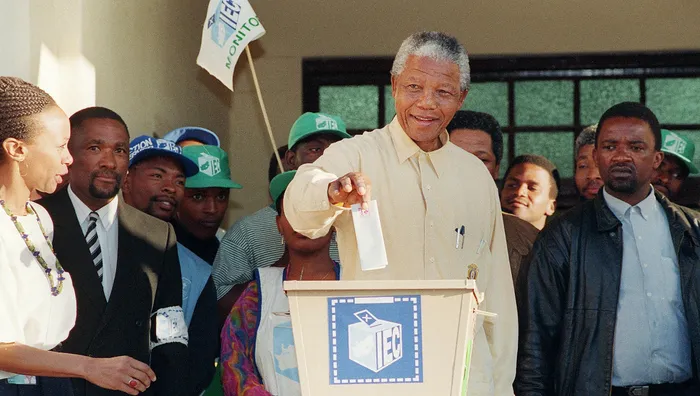
Nelson Mandela casts his vote at the John Langalibalele Dube’s Ohlange High School in Inanda, near Durban, on April 27, 1994. In a nation as young as ours, belonging cannot be left to chance or automatic forces of historical change, says the writer.
Image: AFP
Eddy Maloka
The South African migration crisis exemplifies how challenging it is for the idea of belonging to find expression in human society. Humans are social beings who live within the context of others and on a territory. What complicates our sense of belonging today is the Westphalian state system, which originated in Europe in the 17th century.
The modern state is an egomaniac: it claims people as its citizens; it is also territorial — it fences off a piece of land that it claims as its exclusive property. The geographic borders of this territory are sacrosanct, enshrined in the country’s constitution. The people it claims as its citizens are documented every step of the way, from birth to death.
Contrary to what many of us think, South Africans’ sense of belonging has evolved. Jan Smuts had his own sense of South African belonging when he was Prime Minister in the 1920s, and so did Hendrik Verwoerd when he enforced the apartheid policy in the 1950s. Founded in 1912, the ANC promoted a notion of South African belonging against tribalism.
The Freedom Charter in 1955 said: “South Africa Belongs to All who Live in It,” while Nelson Mandela’s post-1994 efforts aimed to build a “rainbow nation.” Our Coloured community and other groups also share their views on this contested concept, as reflected in books like Belonging: A History of Indian South Africans.
Who belongs here? Political parties have exploited this difficult question to define themselves and identify their target constituency. The ANC has defined who belongs here through its four-national groups thesis: Africans, Coloureds, Indians, and Whites. The Democratic Alliance has sought to base its politics on mobilising what it calls “minorities”—the Whites, Indians, and Coloureds – as a group whose interests need protection under “black-majority rule.”
Other parties have chosen a narrower definition of who truly belongs here, sometimes relying on race or ethnic nationalism. We hear loud calls for secession from certain quarters in the Western Cape and KwaZulu-Natal, and we still have in our midst uncompromising Pan-Africanists who wish to see South African whites sent to the sea.
This issue of belonging is not only difficult in politics; it also causes debate within the intellectual community. The widely accepted and rarely contested indigenous thesis states that black Africans are indigenous to South Africa and thus the primary claimants to the country’s land.
However, this thesis is challenged by the “First People” view proposed by some Khoisan intellectuals, who rightly argue that Bantu-speakers may be African, but they are migrants from Central Africa who settled in the southern tip of the continent — an area occupied for millennia by Khoi and San communities.
During the colonial era, and as recently as the 1960s, settler scholarship propagated a false thesis of the “empty land”. According to this myth, parts of South Africa that came to be occupied by European settlers were “empty” and therefore could not be claimed by anyone.
A related argument suggested that the Bantu-speaking migrants from Central Africa arrived in South Africa around the same time European settlers landed at the Cape in the 16th century. Neither of these claims is accepted today, as research has disproved their premise.
Somewhere in this South African debate about belonging, three thematic questions emerge: race, class, and gender. All black people (African, Coloured, and Indian) did not belong here in the colonial structure of our society. White women were somehow not fully part of the belonging group, only granted the right to vote in 1930.
As for the working class, their right to belong could be limited to providing their labour to power the economy. Beyond that, their claim to belonging is restricted by many barriers to entry into the belonging group.
By now, it should be clear that the concept of belonging is linked to rights and entitlements. In a modern state, such rights may be guaranteed in the constitution. A member can happily enjoy the rights granted to group members and receive entitlements. This is where expectations come into play.
A member can rightfully take legal action to defend or seek redress when denied the rights and entitlements of the belonging group. However, emotions can become uncontrollable, with neighbours turning against each other, if natural resources or access to public goods are at stake. The circle of who belongs can shrink to the smallest.
Now, the foreigner enters our modern context of high international migration. Everywhere they go, foreigners are confronted with the geographic borders of the Westphalian state and the social boundaries that determine who truly belongs. These borders are influenced by racial, class, and other stereotypes. A foreigner from Europe or the USA tends to fare better in Africa, where the racial hierarchy established during colonial times already grants them superiority.
The wealthy have enough means to shield themselves from the chaos around them. In contrast, the poor African foreigners are less fortunate, whether in their own continent, Europe, the US, or elsewhere in the world.
Regardless of nationality, their skin colour largely predetermines how they are received in the host country. On his continent, he has to hassle with locals in the same fishing pond. In Europe and the USA, the white far-right has him in their crosshairs.
The margins are narrow in this sensitive topic, often requiring adjudication by the VAR. Is belonging determined by the legal document you hold, or by your place of origin? In the South African context, this sense of belonging can also be dated to before or after 1994.
Before 1994, race was a key factor. Mandela’s rainbow nation united us behind the Springbok and Bafana. In 1996, his government introduced the SADC Amnesty, granting permanent residence to undocumented foreign nationals from our neighbouring countries.
Thabo Mbeki’s “Two Nations” speech of May 1998 to the South African Parliament highlighted that, despite gaining political independence from apartheid, the country remained divided into two nations: the First Nation of white, wealthy, prosperous individuals with access to a developed economy and infrastructure, and the Second Nation, the majority, black, impoverished people with limited opportunities.
Looking at images of anti-migrant demonstrators rolling on our TVs raises another meaning – the power to define who belongs. You can see this power in full display, in how the marchers dominate the street, in their song that drowns out any dissenting voice. Their sticks held aloft like a clenched fist are sending an unequivocal message to anyone daring to challenge their authority to define our nationhood.
In such a scenario, belonging is more than just about legality, inalienable borders, or a violated territory, but also about the broader category of “we” and “them”. You belong if you agree; you don’t if you hold a different opinion.
What is to be done, as Vladimir Lenin once asked?
Clearly, in a nation as young as ours, belonging cannot be left to chance or automatic forces of historical change. We must be deliberate in cultivating it continuously – in schools, through our religious centres, in our media, and through pronouncements by our leaders. It is not enough to memorise our national anthem by heart.
We can sing every day, pledging our loyalty to the flag. But that alone will not suffice. Our education system and media must plant the consciousness of our collective belonging in our outlook. Our leaders will also need wisdom to hold the fort in tough moments when the water is spilling over the rim — to be what moorings are to a ship on a stormy day.
* Eddy Maloka is Professor at the Wits School of Governance. He writes in his personal capacity.