National Renewal: Charting a Path Forward Amid Multiple Crises
MANDELA DAY
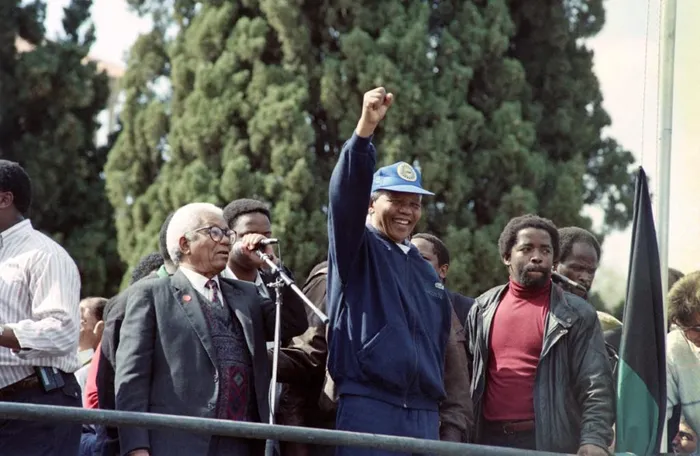
Then ANC deputy president Walter Sisulu (left) and then president Nelson Mandela addressing more than 70 000 supporters at the Union Buildings on August 5, 1992. Mandela’s generation dismantled apartheid not because success was guaranteed, but because surrender was unacceptable, says the writer.
Image: AFP
Zamikhaya Maseti
Every year, the month of July occupies a special place in the South African calendar.
It is the month in which we celebrate the life and legacy of Nelson Rolihlahla Mandela, whose birthday, 18 July, was declared by the United Nations as Mandela Day in 2009. It was an honour bestowed not only upon Mandela himself, but also upon the people of South Africa and the African National Congress, the liberation movement to which he dedicated his life and for which he endured twenty-seven years of imprisonment.
Across our country, Mandela Day has become synonymous with acts of charity and compassion. South Africans devote 67 minutes of their time to cleaning schools, planting trees, feeding the hungry, donating blankets, supporting orphanages, and assisting vulnerable communities.
Non-governmental organisations, churches, businesses, and ordinary citizens all participate in these humanitarian activities. These acts of kindness reflect the generosity and humanity that Mandela embodied throughout his life.
Yet, as noble as these initiatives are, we must ask whether they are sufficient to honour the depth of Mandela's vision for South Africa.
Mandela now rests peacefully in Qunu, the village that shaped his earliest understanding of community, leadership and African identity. The democratic South Africa over which he presided as the country's first democratically elected President continues to confront profound challenges.
Unemployment remains stubbornly high. Crime continues to undermine the security of communities. Poverty and inequality still define the daily experience of millions of South Africans. The promise of a united Rainbow Nation appears increasingly strained as racial, class, and social divisions continue to widen.Recent events have further exposed these fractures.
The departure of some Afrikaner families to the United States after claims of persecution generated intense international debate and political controversy. At the same time, thousands of South Africans have taken to the streets under the banner of the March and March movement, expressing deep frustration over illegal immigration, unemployment, and the capacity of the State to enforce immigration laws.
Whatever one's political position may be, these demonstrations revealed a society wrestling with anxiety, insecurity, and declining confidence in public institutions.
Equally concerning are the allegations of organised criminal infiltration into State institutions that have emerged through recent public disclosures. The work of the Madlanga Commission and the courageous interventions by Lieutenant-General Sibusiso Nhlanhla Mkhwanazi have once again forced South Africans to confront uncomfortable questions about the resilience of our democratic institutions and the extent to which organised crime may seek to influence the State.
Regardless of the eventual findings of the Commission, the allegations themselves demand vigilance, accountability and institutional renewal.These are the realities unfolding while Mandela rests in Qunu.
One cannot presume to know what Mandela himself would say about contemporary South Africa.
History does not permit us to place words into the mouths of those who are no longer with us. Yet it is reasonable to ask whether the country is living up to the constitutional democracy, ethical leadership, and social justice that he consistently advocated throughout his public life.
Perhaps that is the question Mandela Day ought to compel us to answer.
Have we reduced one of the greatest political legacies in modern history to merely sixty-seven minutes of goodwill? Have we become comfortable celebrating Mandela without embracing the difficult responsibilities that genuine nation-building demands?
Cleaning schools is important. Feeding hungry families is important. Donating blankets during winter is important. Every act of compassion restores a measure of dignity to those who receive it.
However, Mandela's life was never confined to charity alone. His life was dedicated to building institutions. It was dedicated to constitutionalism, reconciliation, ethical leadership, accountable governance, and the pursuit of justice.
He understood that poverty cannot be defeated permanently through charity alone. It requires economic transformation, quality education, capable institutions, honest leadership, investment, employment creation, and a society committed to the rule of law.
Perhaps Mandela Day should therefore evolve into something much greater than a humanitarian occasion.It should become a National Day of Renewal.
A day during which every South African asks difficult questions of themselves before asking questions of the government.
How do I contribute towards rebuilding my community? How do I uphold the Constitution? How do I combat corruption wherever I encounter it? How do I reject criminality, racism, tribalism, xenophobia, and political intolerance? How do I contribute to creating employment, supporting education, and strengthening social cohesion?
Nation-building cannot be outsourced exclusively to the State. Neither can the government abdicate its constitutional responsibilities by expecting citizens alone to solve structural challenges.
Mandela understood that democracy requires an active partnership between an ethical State and an active citizenry.South Africa today stands at an important historical crossroads. The Republic possesses extraordinary constitutional foundations, abundant natural resources, and remarkable human talent.
Yet these advantages can easily be undermined by corruption, weak institutions, organised crime, unemployment, and declining public trust.
History teaches us that nations rarely collapse overnight.
They weaken gradually when citizens lose faith, when institutions become compromised, and when leadership fails to rise above narrow political interests.Mandela believed that South Africans possessed the capacity to overcome seemingly impossible obstacles.
His generation dismantled Apartheid not because success was guaranteed, but because surrender was unacceptable.
Our generation faces a different struggle. It is the struggle to consolidate democracy, restore ethical governance, create inclusive economic growth, secure our borders within the framework of the law, strengthen public institutions, and rebuild confidence in the future of our Republic.
That struggle cannot be won in sixty-seven minutes.It requires commitment every day of the year. As South Africans commemorate Mandela Day this July, let us certainly continue cleaning schools, feeding the hungry, and supporting the vulnerable.
These acts remain noble expressions of our humanity. But let us also dedicate ourselves to something even greater: rebuilding the Republic that Mandela and countless freedom fighters sacrificed to create.
Only then will Mandela Day cease to be merely a symbolic annual ritual. It will become a living national commitment to justice, ethical leadership, constitutional democracy, and shared prosperity.
That would be the most meaningful tribute we could offer to the enduring legacy of Nelson Rolihlahla Mandela.
* Zamikhaya Maseti is a Political Economy Analyst.
** The views expressed do not necessarily reflect the views of IOL or Independent Media.