Dina Pule's Return: A Sign of the ANC's Ethical Failure?
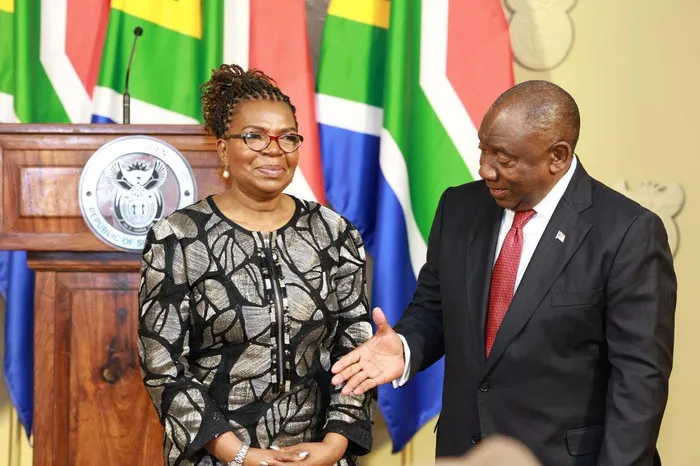
President Cyril Ramaphosa (right) congratulates Dina Pule following her appointment to Cabinet as Minister of Social Development on July 1. Many South Africans will conclude that the ANC has once again prioritised political allegiance over ethical renewal in the case of Pule's return, says the writer.
Image: GCIS
Dr Xolisile Ngumbela
Not only is Dina Pule's selection as Minister of Social Development unexpected, but it is also politically volatile. Any last hope that the ANC's widely reported revitalisation drive is about reestablishing moral leadership has been dashed.
Rather, it strengthens the increasing belief that political rehabilitation is inevitable while accountability is just temporary within the ANC. South Africans have a right to ask a challenging question: Has the ANC given up on ethical renewal in favour of shielding its political insiders if a leader who was previously found by Parliament to have violated the Executive Ethics Code can return to one of the nation's most socially significant Cabinet portfolios?
After the disastrous years of corruption and state control, the ANC has been speaking fervently for years about regeneration, clean governance, and restoring public trust. However, appointments like this one present a very different picture. They contend that ethical controversy is now only an interruption rather than a barrier to high rank in the ANC. Political survival is more important than political integrity.
There is no greater irony. The Department of Social Development was established to safeguard South Africans who are most at risk, including the impoverished, children, the elderly, and those with disabilities. It is a department that ought to represent empathy, honesty, and public confidence.
Rather than focusing on service delivery, the leadership appointment has turned into yet another national ethics controversy. Perhaps the ANC should cease referring to it as renewal if it entails recycling leaders whose moral character has already been called into question through formal accountability procedures. What South Africans are seeing is political recycling disguised as reform, not rebirth.
The growing discrepancy between the African National Congress's rhetoric of rebirth and its actual political practices has once again been made clear by the appointment of former Communications Minister Dina Pule to another position of public responsibility, Minister of Social Development.
The ANC has failed its own test if rebirth entails regaining public trust, reestablishing moral leadership, and exhibiting zero tolerance for wrongdoing. The ruling party has been telling South Africans for years that it has learned from the period of corruption, state capture, and eroding public confidence. It has consistently pledged accountability, moral leadership, and organisational transformation.
However, those promises seem more and more hollow each time people whose records have previously been deemed unethical are reinstated in positions of power. For this reason, there are many different people involved in the issue surrounding Dina Pule's homecoming. It concerns what the ANC awards, what it pardons, and the message it conveys to millions of South Africans who believe that only leaders with impeccable integrity should hold public office.
After Parliament's Joint Committee on Ethics and Members' Interests discovered that Pule had violated the Executive Ethics Code by deceiving Parliament and unlawfully enriching her love partner during official government events, her term as Communications Minister came to an abrupt end. She was eventually fired from the Cabinet as a result of those conclusions. These were conclusions drawn from constitutional accountability procedures designed to maintain moral governance, not just political disputes.
Therefore, the question is straightforward: what does the ANC mean when it talks about rebirth if unethical behaviour has no long-term political repercussions? The response seems more and more awkward. It appears that the ANC has adopted a renewal strategy that modifies language but not culture. A culture of entitlement should be replaced with one of accountability as part of renewal.
Rather, after controversies have gone from the news, the public is increasingly seeing a trend where politically connected people return to positions of power. This gives the impression that political allegiance takes precedence over moral behaviour.
Public trust is possibly the biggest casualty. The currency of democratic governance is trust. Because people think the government serves the public interest rather than private interests, citizens voluntarily follow the law, pay taxes, and engage in democratic institutions. The social compact is weakened by each contentious appointment. The ANC regularly makes the case that people should be given another chance.
Indeed, there should always be space for redemption in a democracy. However, redemption is not a given. Genuine accountability, admission of guilt, proof of rehabilitation, and a strong argument that lessons have been learnt are all necessary. What is offered as redemption could be mistaken for political protection in the absence of these components. The larger message that these selections represent to honest public servants must likewise be acknowledged by the ruling party.
Despite challenging conditions, thousands of civil servants, educators, nurses, police officers, academics, and municipal officials in South Africa act morally on a daily basis. Many refuse to misuse public resources while working under extreme pressure. The highest levels of integrity are demanded of them.
However, it is extremely depressing when powerful political figures who have previously been the subject of unfavourable ethical judgments are reinstated. It implies that the application of ethical responsibility varies according to a person's political status.
For this same reason, the ANC's renewal initiative finds it difficult to persuade doubtful supporters.
Ethical leadership would take precedence over factional tolerance in a true revitalisation program. It would improve merit-based appointments, elevate new leaders with spotless records, and show that public trust is more important than political expediency.
Rather, South Africans consistently witness what seems to be the recycling of political elites. As a result, there is a perilous belief that ANC political careers are rarely terminated by ethical transgressions. Controversial appointments provide the appearance that wrongdoing may impede advancement but does not always exclude future promotion, rather than signifying a clear break with the past.
Regardless of how accurate that perception is, it is detrimental to politics since public trust is shaped by perceptions. The growing perception among the public that the ANC prioritises its own interests over the integrity of public institutions should cause serious worry. Constitutional democracy is significantly impacted by this view.
Ethical governance is important to public management, according to the South African Constitution. Public office is not a political right, but rather a public trust. It is required of leaders to use their authority honestly, openly, and in the people's best interests.
Trust in democratic institutions declines when nominations seem to be at odds with those ideals.
It's quite ironic. Leaders who exemplified ethical leadership via their personal sacrifices were previously the source of the ANC's moral authority. Numerous individuals, including Nelson Mandela, Walter Sisulu, Albertina Sisulu, Oliver Tambo, and many more, recognised that leadership required both political commitment and personal honesty.
Millions of people trusted the ANC because of its moral capital. The organisation runs the risk of wasting that legacy today. A conference resolution, a campaign slogan, or a public relations ploy alone cannot constitute renewal. Decisions determine renewal. It is seen in who is promoted, who is held responsible, and what expectations are placed on those who hold public office.
Renewal becomes little more than political rhetoric if people who have previously been determined to have breached ethical standards by official processes may easily return to positions of influence without a clear display of accountability and regained public trust.
Better is what South Africans deserve. They should have a ruling party that shows by its deeds that moral leadership is uncompromising. They should be appointed to positions that generate trust rather than controversy. They should live in a political environment where integrity is valued, and accountability is genuine.
Until then, the ANC will still find it difficult to convince the public that it has truly moved past its difficult past. Without responsibility, renewal isn't renewal at all. Under the guise of reform, it is really the recycling of well-known faces. Convincing South Africans that the ANC has changed is consequently its biggest obstacle. Proving it is its biggest obstacle. That assertion is either strengthened or weakened by each appointment.
Many South Africans will conclude that the ANC has once again prioritised political allegiance over ethical renewal in the case of Dina Pule's return. This is a cost that not only the ANC will bear, but it also runs the risk of further undermining public trust in democratic administration.
* Dr Xolisile Ngumbela is Assistant Dean: Teaching and Learning at the Central University of Technology's Faculty of Management Sciences.
** The views expressed do not necessarily reflect the views of IOL or Independent Media.