Afrikaners' Great US Trek in Turmoil As Pushback Intensifies
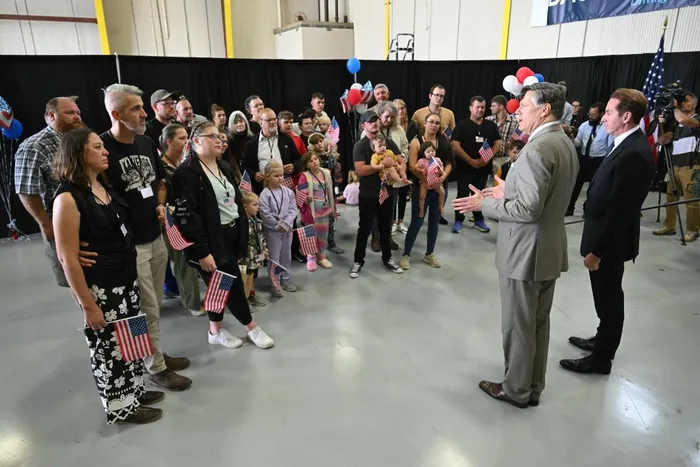
Newly arrived Afrikaners' listen to U.S. Deputy Secretary of State Christopher Landau (centre) and Homeland Security Deputy Secretary Troy Edgar (right) deliver welcome statements in a hangar at Washington's Dulles International Airport on May 12, 2025. Many Afrikaners seem to struggle with one thing: being part of a South Africa that belongs to all of us, says the writer.
Image: AFP
Eddy Maloka
I was not surprised to learn that the US asylum programme aimed at rescuing Afrikaner “refugees” from “white genocide” in South Africa by bringing them across the Atlantic Ocean has encountered a setback.
As the Afrikaners were heading to the US in one direction, the Latinos were moving in the opposite direction, being pushed out of that country thanks to MAGA’s mass deportation programme. How were these Afrikaners going to be welcomed into an American nationhood when African-Americans still feel excluded from it? How were these Afrikaners going to be embraced by a nation that is still struggling with accepting its Native American citizens fully?
This asylum programme may seem irrational at first glance, but there is a reason behind it. Its logic can be traced to the controversial “Great Replacement Theory” associated with the French writer Renaud Camus, which claims that a deliberate plan is being orchestrated by “liberal” elites to replace white people in Western countries with non-white immigrants through unlimited mass migration to engineer the extinction of the white race.
This conspiracy theory has supporters within MAGA circles, and if media reports are to be believed, Elon Musk is among its outspoken supporters. While denying he is a racist, Musk has nonetheless used his social media platform X to share views that verge on this theory. “Whites are a rapidly dying minority,” he is quoted in The Guardian article of February 2026, “Elon Musk posted about race almost every day in January”.
In March 2024, on America’s Voice, a blog titled “Musk’s Ongoing Amplification of the Replacement Theory Uses Immigrants To Sow Election Distrust” was published, revealing that: “X owner Elon Musk has been under fire in recent months for his unapologetic platforming of the white nationalist and anti-Semitic “replacement” conspiracy theory to more than 170 million followers on the platform formerly known as Twitter.
In just one of his repeated claims, Musk falsely stated that the Biden administration has a “strategy” to “get as many illegals in the country as possible” to create a “permanent majority” for Democrats.”
The “Great Replacement Theory” connects the white “genocide” narrative, the asylum programme, and Musk as a key figure strategically positioned as a confidant of US President Donald Trump, a MAGA insider, and a major donor. “President Donald Trump has signed an executive order cutting U.S. aid to South Africa, following claims he has made about the country discriminating against white farmers,” reported NBC News in February 2025.
This report continued: “The executive order comes after a new South African land law went into effect. In focusing on South Africa, the president is echoing the views of … Elon Musk, who was born and raised in South Africa. The world’s richest man and now a member of Trump’s inner circle, Musk has described his birth nation as having “racist ownership laws,” accusing its government of doing too little to stop what he has referred to as a “genocide” against white farmers.”
A layperson reading these reports may conclude that the Afrikaner asylum programme seeks to counter what the “Great Replacement Theory” has identified as an existential threat to the white race. The intake of Afrikaner “refugees” might boost white population numbers in the US, while an aggressive immigration crackdown is decreasing the demographics of brown and black people.
I cannot claim to be an expert on such a complex people from simply reading Hermann Giliomee’s The Afrikaners: A Concise History. However, the little I know about Afrikaners is that they are as South African as our Pinotage wine, which is produced from a grape variety invented in 1925 by Abraham Izak Perold in Stellenbosch.
This grape developed on our soil as a cross between Pinot Noir and Cinsaut. Similarly, Afrikaners developed on South African soil from a blend of the Dutch and the French Huguenots, in the environment of the Cape slave community that included Malay slaves, Khoi, and San people. The Afrikaans language is uniquely South African, a product of our history.
Fortunately, only a few Afrikaners enrolled in the asylum programme. But one question is unavoidable: is this Afrikaner search for a new home across the Atlantic a replay of the 19th-century Great Trek of their ancestors from the Cape? Perhaps.
Many Afrikaners seem to struggle with one thing: being part of a South Africa that belongs to all of us. Some even go further to seek a sense of belonging in the apartheid ideology of “separate development” and in Bantustan-style solutions, rather than among us, to be equals among the equals.
The Great Trek was an escape of forebears of the Afrikaners, away from the British they resented. It was also a journey into the unknown inland of South Africa. Dominant Afrikaner political formations perpetuate this Trek mentality of a people who face extinction and have to escape to a white racial paradise for safety and prosperity.
To this mindset, Orania is a dreamland, not an isolated, desolate place in the Northern Cape. As a result, many Afrikaners try to find comfort in exclusive minority spaces on matters of race, language, culture, and religion, even though the future of our country is actually draped in the colours of a rainbow.
Paradoxically, a people who are a blend like our Pinotage could be a captive of the idealism of racial exclusivity. FW de Klerk belonged to a different league of Afrikaners. He was brave when he broke ranks with the apartheid system in 1990 and chose a new path towards an inclusive South African nationhood. But he did not stop there.
Following his death on November 11, 2021, his foundation released a video posthumously in which he issued a wholehearted apology for apartheid, stating, “I, without qualification, apologise for the pain and the hurt and the indignity and the damage that apartheid has caused to black, brown and Indian people in South Africa.”
I was encouraged to hear another prominent Afrikaner, chairman of Shoprite and Pepkor, Christo Wiese, recently echo de Klerk’s sentiments. In his “message to people who want to leave South Africa “, he reportedly advised: “I’m staying for several reasons, but the main reason is I believe the majority of people in South Africa are good people… There are countries where you cannot say that. But the majority here are good people, and that, in the end, will matter.”
It remains to be seen how far the Trek mindset will hold the fort against the countertrend represented by de Klerk’s vision and Wiese’s Proudly South African optimism. I hope that this Trek, which is taking some of our Afrikaner compatriots to the Americas and others to Orania and private Afrikaans schools and churches, will one day find a leader who is not afraid of a South African future that we will all share.
Afrikaner nationalism may explain this fear, anxiety, and siege mentality. It emerged in the terrain of struggle on South African soil, forging this identity. However, leaders were essential at every stage in transforming it into a movement, and leadership remains crucial even today in helping Afrikaners see South Africa as an indivisible nation.
One way to avoid getting lost in a maze of a Trek mind is to consider Plato’s “Myth of the Soulmate” from his literary work Symposium, where the character Aristophanes described humans as originally powerful, conjoined beings whom Zeus split in two as punishment. This division caused humankind to roam the earth in search of their missing “other half.”
Alternatively, Rumi’s philosophy of love may provide another perspective, as this 13th-century Persian sage poetically wrote, “The minute I heard my first love story, I started looking for you, not knowing how blind that was. Lovers don’t finally meet somewhere. They’re in each other all along.”
* Eddy Maloka is a Professor at the Wits School of Governance. He writes in his personal capacity.
** The views expressed do not necessarily reflect the views of IOL or Independent Media.