Local Polls a Path to Realising Madiba's Vision for Economic Justice
MANDELA DAY
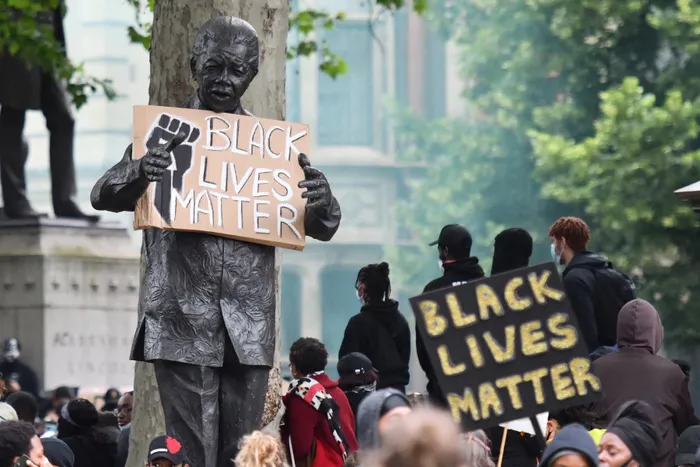
A statue of former South African president Nelson Mandela is seen holding a Black Lives Matter placard in Parliament Square, central London after a demonstration outside the US Embassy, on June 7, 2020. Mandela Day should renew our commitment to building an economy that creates decent work, strengthens public institutions and shares prosperity more equitably, says the writer.
Image: AFP
Dr. Reneva Fourie
Every year on 18 July, Mandela Day inspires South Africans to dedicate 67 minutes to serving their communities in honour of the country’s inaugural democratic President’s selfless commitment to justice, human dignity and solidarity.
The gesture carries significant symbolic value, but the spirit of Mandela Day demands a deeper determination to rebuild South Africa.
The persistence of exceptionally high unemployment, entrenched inequality, widespread economic insecurity and pervasive social violence continues to affect communities across the country, requiring that we demonstrate the same courage, determination and collective purpose that defined the struggle against apartheid.
Today, rather than resistance alone, we must champion reconstruction to realise the inclusive and prosperous South Africa that Madiba and his generation envisioned.
The battle against poverty and inequality begins by addressing the deep structural challenges that continue to stifle the country’s development. South Africa is blessed with extraordinary natural wealth.
Minerals, fertile agricultural land, and countless other resources contribute significantly to the economy. Yet much of this wealth benefits only foreign shareholders and a small domestic elite, while millions of South Africans languish in poverty, struggling with the rising costs of food, fuel and essential services.
Citizens must drive a change in economic trajectory. The South African Reserve Bank's prioritisation of inflation targeting places insufficient weight on employment and inclusive economic development.
Financialisation and monopoly capital are additional structural inhibitors. Large volumes of capital remain concentrated within financial markets rather than being invested in productive industries capable of creating decent work.
Economic activity remains concentrated among a relatively small number of large firms across several sectors, while small businesses, cooperatives and community enterprises continue to face barriers, including limited access to finance, procurement opportunities and affordable credit.
Supporting cooperative development and expanding local procurement can help diversify economic participation while creating employment opportunities within communities. Consumers also have a role to play by supporting local businesses where practical, thereby strengthening local economies.
Although public procurement should be leveraged to build small, micro and collective enterprises, the state should not cede key functions to the private sector. Time and again, public contracting has been weaponised by politically connected elites who plunder state coffers while often delivering substandard services.
Turning essential public functions into commercial playgrounds strips citizens of their rights and converts public need into private profit. Strengthening public institutions, improving accountability and investing directly in state capacity can reduce waste, improve service delivery and ensure that public resources serve the broader public interest rather than private enrichment.
Our current energy system highlights the catastrophic risk of subjecting strategic operations to public-private partnerships. Instead of socialising South Africa's abundant solar and wind reserves, the state has allowed private capital to commodify the climate, selling us back our own sunlight and air for profit.
What began as the backdoor privatisation of energy generation has culminated in independent power producers bleeding Eskom dry with predatory, locked-in rates, while South African coal fuels the imperialist genocide of Palestinians and aggression in Lebanon and Iran.
The continued unbundling of Eskom, now targeting the national transmission grid, constitutes the ideological plundering of our collective inheritance. We must resolutely resist surrendering the backbone of our energy network to market forces. Capitulating to energy liberalisation strips the public of the right to plan, direct and insulate the economy for the collective good.
The Komati transition should be the starting point for restoring public sovereignty at Eskom. Although constrained by the restrictive, market-driven conditionalities of the $497 million World Bank loan, it nevertheless offers the opportunity to establish a fully state-owned centre for green industrial production that reaches far beyond electricity generation.
Expanding this model into a larger regional industrial centre could help offset the local economic hardship caused by coal plant closures, while ensuring that workers receive meaningful retraining and new opportunities rather than relying heavily on external consultants. Communities themselves should play an active role in shaping an energy transition that is socially just, locally owned and economically inclusive.
South Africa now faces the risk of a similar trajectory in the water sector as it faced with electricity as Operation Vulindlela extends to municipal services. Starving infrastructure maintenance and degrading water quality are symptoms of a state surrendering its core functions, directly benefiting predatory water tanker syndicates. Water must remain under democratic public ownership and accountability.
The question of land remains equally urgent. Landlessness, spatial inequality and the housing crisis continue to shape daily life for millions of South Africans. Empty buildings in Johannesburg and Cape Town stand neglected while families endure overcrowded informal settlements, unsafe living conditions and homelessness.
Public land and abandoned properties should be used more effectively to meet social needs. Suitable land should support community food gardens that strengthen local food security, while vacant urban buildings should be converted into mixed-income, high-density social housing that allows more people to live close to employment opportunities, public transport and essential services.
As we strive to realise the vision of Madiba and his contemporaries, we must appreciate that they consistently located South Africa within a broader African and international context. Madiba understood that South Africa formed part of a wider African community shaped by shared histories of colonialism, solidarity and liberation.
Addressing the Summit of the Organisation of African Unity three decades ago, Madiba acknowledged the continent's support by declaring, “We are indebted to you for struggling on our side as brothers and sisters to reclaim our common dignity.” That commitment to international solidarity remains relevant today.
Building a great South Africa requires confronting the structural causes of its problems rather than managing their consequences. Mandela Day should therefore inspire more than acts of charity. It should renew our commitment to building an economy that creates decent work, strengthens public institutions and shares prosperity more equitably.
Nelson Mandela understood that democracy depends on active, organised citizens who shape the future beyond the ballot box. Voting on 4 November is imperative, but by also strengthening civic organisations, demanding accountable governance and advancing solidarity across communities, South Africans can help realise the democratic, socially just and inclusive society that Madiba and generations of freedom fighters originally envisioned.
* Dr Reneva Fourie is a policy analyst specialising in governance, development and security.
** The views expressed do not necessarily reflect the views of IOL or Independent Media.