Unpacking India's Evolving Nuclear Strategy Amidst Regional Threats
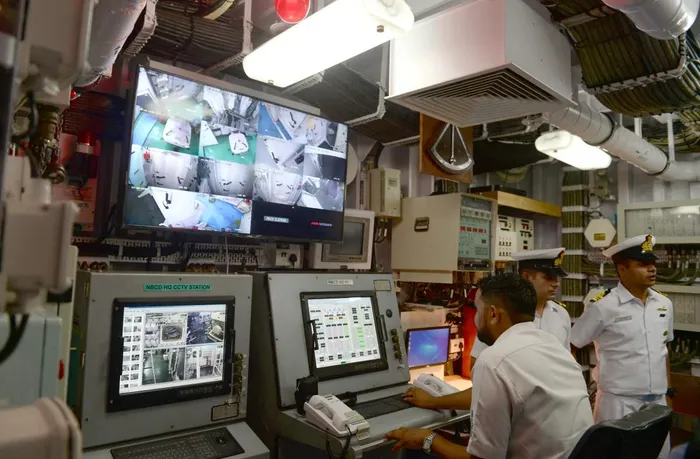
Indian Navy sailors monitor screens inside the Nuclear Biological Chemical Defence and Damage Control (NBCD) room of the INS Chennai ahead of its commissioning into the Indian Navy in Mumbai on November 18, 2016.
Image: AFP
Air Marshal Anil Chopra (Retired)
According to the Stockholm International Peace Research Institute (SIPRI) Yearbook 2026 published in June, India has operationally deployed 12 nuclear warheads for the first time. This marks a significant departure from decades of cautious policy where India strictly stockpiled warheads and delivery systems in separate locations.
The newly deployed warheads are believed to be nested within its nuclear submarines and potentially underground missile silos to shorten reaction times. The assessment highlights that India’s total estimated inventory has risen from 180 warheads last year to 190 currently.
The report claims that this is the first time part of India’s arsenal has been classified as operationally deployed rather than just stockpiled. This shift signals the maturation of India’s sea-based deterrent and heightened readiness to counter rapidly expanding arsenals in the region (such as that of China, for instance).
Despite this operational shift in posture, India maintains its foundational No-First-Use (NFU) doctrine. India’s capability is designed purely to deter potential aggressors rather than engage in an arms race.
India faces a uniquely fraught security environment, with two nuclear‑armed neighbours. New Delhi has ongoing territorial disputes and a history of war with both of them. It is therefore important to understand how India’s deployment compares with the nuclear postures of China and Pakistan.
China’s nuclear weapons program
China possesses the world’s third-largest nuclear arsenal, with an estimated stockpile of over 620 warheads, SIPRI estimates. The program is undergoing a rapid modernisation and expansion, shifting from a historical policy of “minimal deterrence” to a robust nuclear triad. Since its first nuclear test in 1964, China has maintained NFU as the official policy.
The primary purpose of China’s modernisation is to ensure a secure “second-strike” capability. China continues to upgrade its supporting infrastructure, including plutonium production capabilities and advanced explosive testing facilities.
Pakistan’s nuclear weapons program
Pakistan possesses an estimated 170 nuclear warheads, making it the sixth-largest nuclear-armed state globally, the SIPRI report shows. Initiated in 1972, its nuclear weapons program was a response to regional tensions with New Delhi. Pakistan, like India, is not party to the Nuclear Non-Proliferation Treaty (NPT). Islamabad’s nuclear strategy is based on “full-spectrum deterrence,” designed primarily to counter conventional military threats. Pakistan, moreover, does not maintain an NFU posture.
Its arsenal is deployed across a nuclear triad of land, air, and sea capabilities. Storage of its nuclear payloads is well spread at different locations.
India’s nuclear triad
India’s nuclear triad is a three-pronged military force structure that allows the country to launch nuclear strikes from land, air, and sea. Fully operational since 2018, the triad underpins India’s nuclear doctrine of credible minimum deterrence (CMD) and its NFU policy.
The land leg forms the backbone of India’s strategic deterrence and relies heavily on the indigenous Agni series of surface-to-surface ballistic missiles. Agni-V is an Intercontinental Ballistic Missile (ICBM) with a range exceeding 5,000 km and capable of reaching targets deep within Asia and Europe. The Agni-P and Agni-IV are advanced intermediate-range missiles ensuring complete coverage of the immediate region.
The air-based component (aircraft) provides flexible deployment and yield options. India’s airborne nuclear delivery is spearheaded by multi-role fighter-bombers equipped with nuclear gravity bombs or standoff missiles.
The sea leg is the most survivable and secretive part of the triad, ensuring India retains a robust second-strike capability even if land and air bases are destroyed. The fleet consists of indigenous Arihant-class Ship Submersible Ballistic Nuclear (SSBN) submarines.
Russia – and before it, the Soviet Union – has been India’s principal external partner in both its conventional and nuclear submarine journey, providing technology, training and long-term lease arrangements that helped lay the foundation for India’s indigenous undersea deterrent.
Pillars of India’s nuclear doctrine
New Delhi’s nuclear doctrine, formalised and released in 2003, is anchored on two core pillars: a strict NFU policy and a posture of CMD. It emphasises civilian command, massive retaliatory strikes, and a commitment to global nuclear disarmament.
India has committed to only using nuclear weapons in retaliation against a nuclear attack on Indian territory or on Indian forces anywhere. If deterrence fails and India is subjected to a nuclear strike, the retaliation is designed to be massive and inflict damage unacceptable to the aggressor.
India will not use or threaten to use nuclear weapons against states that do not possess nuclear weapons. However, India explicitly reserves the right to use nuclear weapons in the event of a major attack on India or its forces using biological or chemical weapons.
India maintains a stringent policy of export controls regarding nuclear and missile-related technologies and remains committed to non-proliferation.
Until now, only the five “official” nuclear weapons powers (the US, Russia, China, UK, and France) had “deployed” nuclear weapons. Even as New Delhi’s doctrine remains unchanged on paper, its nuclear posture is quietly shifting towards greater deployment and readiness, driven by new technology, a maturing submarine force, and the pressures of China’s rapid arsenal expansion.
Security of India’s nuclear assets
India’s Strategic Forces Command (SFC) is an integrated tri-service command responsible for the management, administration, and execution of the country’s tactical and strategic nuclear weapons stockpile. Operating under the Nuclear Command Authority (NCA), it ensures operational readiness and implements all nuclear contingency plans. NCA has the ultimate operational control, and the authorisation to use nuclear weapons lies exclusively with the civilian political leadership. The NCA includes a Political Council, chaired by the prime minister, and an Executive Council, chaired by the national security advisor.
This system incorporated multiple layers of security, including authorisation codes at each stage, and was designed to work quickly if a nuclear emergency ever arose. But while the arrangement was secure and well-tested, it was less suited to rapid response. That is where the need for mated weapons began to emerge.
Strengthening nuclear deterrence
Given its no-first-use (NFU) policy, India must ensure that no surprise attack can neutralise its relatively limited arsenal – especially when compared with the thousands of warheads held by the US and Russia, and the hundreds possessed by China. Some analysts argue that it may be time for India to revisit its NFU posture.
China, for example, has long maintained an NFU policy on paper, but is now rapidly expanding and modernising its arsenal. By that logic, survivability depends not just on doctrine but on numbers and capability, and some believe India may ultimately need an arsenal of around 500 warheads.
India’s next phase of nuclear development is centred on modernising delivery platforms, expanding warhead stockpiles, and strengthening the survivability of its command-and-control systems in response to changing regional threats.
The sea leg is increasingly becoming the backbone of India’s second-strike capability, with stretched Arihant-class submarines entering service and a much larger S-5 class under development.
India has also been testing Multiple Independently Targetable Re-entry Vehicles (MIRVs), which allow a single missile to carry several warheads aimed at different targets, significantly improving its ability to penetrate missile defences.
To preserve a credible NFU posture in an era of faster and more precise adversary technologies, India is prioritising redundant, secure communications and peacetime patrols for its naval nuclear platforms. Even so, India is strengthening its nuclear deterrent slowly, but steadily.
* Air Marshal Anil Chopra (Retired) is an Indian Air Force veteran and the former Director-General of the Center for Air Power Studies in New Delhi. This is an edited version of the article originally published at https://www.rt.com/
** The views expressed do not necessarily reflect the views of IOL or Independent Media.