Restoring Trust: The Urgent Need for Clarity in IDAC's Mandate, Accountability
FIGHTING CORRUPTION
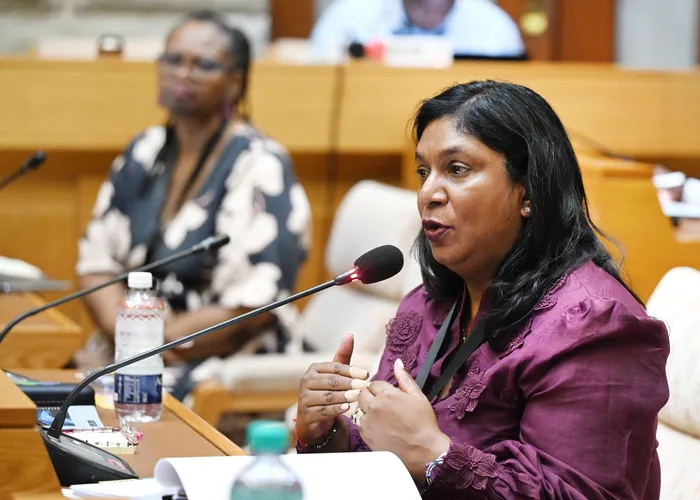
Investigating Directorate Against Corruption (IDAC) head Advocate Andrea Johnson during her testimony at the parliamentary inquiry probing allegations of corruption within the criminal justice system. South Africa needs an anti-corruption agency that is independent, professionally competent and publicly trusted, says the writer.
Image: Phando Jikelo / RSA Parliament
Dr. Reneva Fourie
Over the past few days, the Madlanga Commission, established by President Cyril Ramaphosa in 2025 following allegations of collusion between criminal syndicates and certain politicians, police officials and prosecutors, has placed tensions between the Investigating Directorate Against Corruption (IDAC) and the South African Police Service's Crime Intelligence Division at the centre of its proceedings.
In the absence of IDAC Head Andrea Johnson, who was unavailable to testify due to illness, the commission received evidence from senior IDAC investigator Colonel Brian Padayachee.
Although the commission is still hearing evidence and has not reached any findings, the proceedings have already raised important institutional questions. Allegations have emerged that senior IDAC leadership may have unduly interfered in or influenced investigations, that investigations and prosecutions may have been conducted selectively, and that the organisation faces internal leadership challenges.
Institutional tensions and overlapping mandates between IDAC, the Hawks, SAPS Crime Intelligence and the National Prosecuting Authority (NPA) have also become apparent. Given that the NPA's oversight of IDAC is confined to administrative matters, the central governance question is: who is IDAC operationally accountable to?
IDAC began as a temporary entity, the Investigating Directorate, in 2019 to investigate matters arising from state capture. Following the enactment of the National Prosecuting Authority Amendment Act in 2024, it became a permanent multidisciplinary entity with full policing powers. Its statutory mandate is to investigate and prosecute serious, high-profile and complex corruption, commercial and financial crimes.
The expansion of its powers has elevated its importance within South Africa's criminal justice system, making clarity regarding its institutional position and accountability all the more significant.
The evolution of IDAC has coincided with the development of a high-level partnership between government and organised business through the Business for South Africa (B4SA) platform. Initiated by President Ramaphosa in 2020 in response to the Covid 19 pandemic, B4SA evolved in 2023 from its initial pandemic focus into a broader strategic public governance initiative.
Its principal formal workstreams comprise energy, transport and logistics, which operate in conjunction with Operation Vulindlela, as well as youth employment and crime and corruption. All four technical workstreams report directly to a unified Joint Strategic Operations Committee, anchored within the Presidency, which coordinates the efforts of more than 115 corporate chief executives alongside South African government ministries.
The Joint Initiative to Fight Crime and Corruption (JICC), which is responsible for the crime and corruption workstream, is a strategic coordination mechanism designed to pool public and private-sector resources, expertise and intelligence to combat organised crime and systemic corruption.
This includes forensic accountants, data analysts, digital tools, investigators and other specialist expertise. The JICC complements the capabilities of the public sector, which continues to face budgetary constraints, shortages of specialised skills and procurement delays.
Business has an important role to play in combating crime and corruption. The expertise, resources and specialist capabilities available within the private sector can make a valuable contribution to strengthening the state's investigative capacity.
Nevertheless, important structural and systemic governance risks arise when business leaders head a state structure that directly influences crime and corruption investigations and enjoy full access to intelligence.
Combining the state's coercive authority and classified intelligence with private commercial interests has the potential to erode state sovereignty, judicial impartiality and public confidence if appropriate safeguards and accountability mechanisms are not clearly established.
Even where JICC members conduct themselves with complete integrity, the institutional design itself may give rise to perceptions of a conflict of interest. It creates the perception of privileged access to government and intelligence structures and raises the possibility that investigative priorities affecting particular companies or sectors could be influenced, or that regulatory enforcement could be shaped in ways that benefit particular commercial interests.
Public confidence in criminal justice institutions depends not only upon the integrity of those involved but also upon governance arrangements that are demonstrably independent and transparent.
South Africa is particularly vulnerable to these concerns given its experience of state capture, during which a relatively small group of public and private actors were able to influence state decision-making to extract private benefit while imposing high social and economic costs on the broader population.
The findings of the Zondo Commission illustrate the consequences of weak institutional safeguards. More recently, allegations that Tony Leon lobbied Democratic Alliance ministers to advance particular business interests have again highlighted the sensitivity surrounding the relationship between political authority and private interests.
Regardless of the merits of those allegations, South Africa's recent history makes any contemporary fusion of public authority and private influence a matter requiring careful institutional design and transparent oversight.
There are also operational considerations. Private actors with access to state intelligence may create risks relating to the protection of classified information, intelligence compromise and operational security.
Equally important is the broader public perception of these arrangements. Where intelligence agencies are perceived to serve private rather than exclusively national interests, their institutional credibility, operational effectiveness and public legitimacy may be undermined.
These risks reinforce the importance of ensuring that operational authority, access to intelligence and accountability arrangements are clearly defined.
Private business leaders are not elected public representatives and are not directly accountable to Parliament or the electorate. They are accountable to shareholders, boards and corporate governance structures. Where private actors occupy positions that influence the exercise of state coercive powers, governance arrangements must therefore ensure that public accountability remains clear, transparent and constitutionally appropriate.
Otherwise, a grey area emerges in which it becomes increasingly difficult for Parliament and the public to determine where responsibility for operational decisions ultimately resides.
Against this background, the question of IDAC's operational accountability becomes particularly important. The Head of IDAC is appointed by the Presidency. The JICC, which enjoys a close relationship with IDAC, is located within the Presidency.
The foreign intelligence service, the domestic intelligence service and the National Centre for Intelligence Coordination are likewise located within the Presidency. While this institutional configuration is not unique internationally, the recent allegations concerning political interference in South Africa's law enforcement institutions make transparency regarding IDAC's operational accountability essential.
The entity is too newly established and its mandate too important for uncertainty about its governance arrangements to undermine its credibility.
The future credibility of IDAC depends upon three related principles.
First, its statutory mandate should be precise and leave little room for uncertainty regarding its jurisdiction relative to other investigative bodies.
Secondly, its operational parameters should clearly define its relationship with the Hawks, SAPS Crime Intelligence, the NPA and any external coordinating structures.
Thirdly, and most importantly, its operational accountability must be clearly established. There should be no uncertainty regarding who exercises operational oversight, who reviews operational decisions and through which constitutional mechanisms those decisions are ultimately scrutinised.
IDAC must be permitted to operate free of undue political or commercial influence. The matters it raises must equally not be dismissed on account of the ambiguity surrounding its own mandate and reporting lines.
The allegations involving both Crime Intelligence head Lieutenant General Dumisani Khumalo and Lieutenant General Nhlanhla Mkhwanazi should therefore be investigated thoroughly, independently and in accordance with due process.
Those making allegations must present evidence that is subject to proper scrutiny. Those against whom allegations have been made are entitled to a fair opportunity to respond and, where appropriate, to clear their names. The integrity of the investigative process is inseparable from the integrity of the institutions conducting it.
South Africa needs an anti-corruption agency that is independent, professionally competent and publicly trusted. The recent establishment of the IDAC Ombud, headed by retired Judge Takalani Joseph Raulinga, in terms of Section 22A of the National Prosecuting Authority Act (as inserted by the 2024 Amendment Act), is a welcome step towards strengthening institutional accountability.
While the Ombud is likely to strengthen accountability and public confidence, it does not resolve where IDAC's operational accountability ultimately sits within South Africa's law enforcement and governance architecture. IDAC’s long-term legitimacy will ultimately depend upon whether its mandate is constitutionally grounded and whether its accountability chain is clear.
* Dr Reneva Fourie is a policy analyst specialising in governance, development and security.
** The views expressed do not necessarily reflect the views of IOL or Independent Media.