The Importance of Citizen Participation in Elections
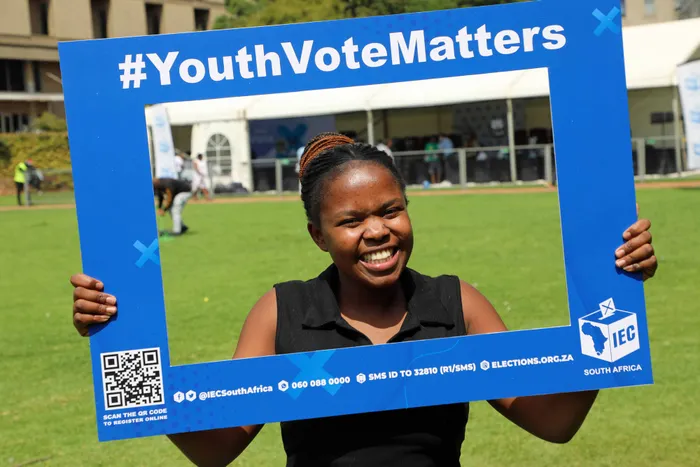
Student Banhle Malwane participating in a voter education campaign conducted by the IEC at Wits University. Elections are intensely passionate and partisan. Citizens do not have to be dispassionate, independent and impartial when they make choices about elections, says the writer.
Image: Timothy Bernard / Independent Newspapers
Dhaya Pillay
Why would citizens participate in elections if they see no benefit for themselves?
Speakers Dr Ben Roberts of the Human Sciences Research Council and Dr Pali Lehohla inspired this question at the Thought Leadership Seminar titled The Disappearing Labour Theory: Understanding Recent Voting Patterns in South Africa’s Elections. The seminar, hosted by the Electoral Commission of South Africa (IEC), aimed to understand why citizens do not participate in elections.
In my closing remarks (below), I responded to the speakers intuitively as an adjudicator.
I emphasised the co-responsibility of citizens and adjudicators for participating in making decisions necessary for the peaceful ordering of society. Then I described the lack of parity of participation between adjudicators and citizens, amongst citizens, and between citizens and elected representatives.
I concluded, as the speakers did, that social injustices account for neither citizens’ apathy nor disinterest, but for disaffection with elections that repeatedly fail to deliver the goods.
Peaceful social ordering
Voters, like adjudicators – judges, magistrates and arbitrators – make choices in different contexts, to reach decisions cumulatively necessary for the common purpose of peacefully ordering society. Otherwise, conflict and chaos would be the order of the day. This is so in a rights-based constitutional democracy with an economy based on capitalism and politics founded on nationalism.
Once adjudicators are seized with a case, they must issue reasoned decisions. Unless they recuse themselves for good cause. However, citizens are neither compelled to register to vote nor to vote.
Adjudicators’ irrational decisions can be reviewed, appealed against and set aside. Adjudicators may also be disciplined if the degree of irrationality amounts to incompetence or misconduct. How citizens participate is an individual’s choice.
A citizen who drops off to sleep during a campaign speech will not suffer punishment as would an adjudicator who dozes during counsel’s argument. Voters may toss a coin to choose a candidate, but adjudicators may not declare a person guilty or not guilty in that way.
Elections are intensely passionate and partisan. Unlike adjudicators, citizens do not have to be dispassionate, independent and impartial when they make choices about elections. They are unaccountable for their decisions to vote or not, and for whom they vote. Ballots are secret.
Even where funding is concerned, citizens participating in elections as political parties and candidates may solicit political funding within certain limits. However, an adjudicator who solicits funding would be disqualified and sanctioned for taking a bribe.
Ramifications
Unlike adjudicators, who are sanctioned as individuals, punishment of citizens for their choices is collective. Citizens must suffer elected representatives who fail to deliver an orderly, constitutionally compliant society. Herein lies the phenomenal burden of co-responsibility on citizens, the weight of which is not fully realised.
Except for precedent-setting decisions and a few others, most of the decisions of adjudicators seldom ramify beyond the parties to a dispute. Collectively, adjudicated decisions incrementally collate over time into a tapestry that ultimately contributes to shaping an orderly society.
Contrastingly, every single decision – and non-decision – of citizens strikes directly and almost instantly on the orderliness or otherwise of the emerging society. Paradoxically, their actions and inaction may also impair the quality of adjudication in the new society, if the newly elected political representatives contaminate the independence, impartiality and integrity of adjudicators.
Recognising these differences between adjudicators and citizens and reviewing their respective weight of co-responsibility for social ordering ought to trigger our concern for the choices citizens make.
Parity of participation
Although there is parity of purpose for decision-making, there is no parity of participation between adjudication and voting. Adjudicators bear a heavier burden when citizens’ participation in elections plummets.
Disparate participation distorts both the balance and separation of powers between adjudication and voting. As citizens relinquish their agency as co-designers of a peaceful social order, adjudicators must then fill the gaps. Adjudicators are saddled with disputes unsuitable for adjudication.
Disputes of interests, such as budgeting, are best determined by citizens. Adjudication is designed for resolving disputes of rights. The misfit of disputes to process shores up in a weakening social order.
We ought to be relieved that adjudication thrives. Escalating disaffection could ripen conditions for more forceful and even violent contestation.
Common purpose and reciprocity
Proliferating litigation about electoral disputes shows that citizens are failing to find common purpose and reciprocity amongst themselves. Without “organisation by common aims and organisation by reciprocity … nothing resembling a society can exist,” said Lon Fuller in his posthumously published article, The Forms and Limits of Adjudication.
The burgeoning of over 550 registered political parties is double the number of companies listed on the Johannesburg Stock Exchange. Is this evidence of a vibrant democracy or a splintering society? Some political parties commoditise votes, announcing that “they’re in it to win it”, to be “kingmakers”.
Political funding pipers call the tunes for elected representatives to play. Once elected, many representatives quickly evolve into an elite entitled class, budgeting in favour of blue lights for themselves, instead of bread for those who voted for them.
Nancy Fraser coined the term parity of participation as a principle of social justice. It embraces the idea that social, economic and political structures must enable everyone to interact with one another for a just society, as equally enabled and empowered peers, regardless of (dis)ability, ethnicity, gender, sexuality or social background.
She advances three pillars of participation:
- Equal distribution of material resources requires distributing wealth to all of society so that there is an equally high standard of living with everyone having the same or similar facilities and opportunities for acquiring wealth and social esteem. (Dr Lehohla graphically illustrated the stark inequality between Sandton and neighbouring Alexandra.)
- Recognition of status refers to cultural values that dismiss members of some groups as less significant, inferior, excluded, or quite simply invisible, subordinate and therefore less deserving of full partnership in society.
- Political voice and representation are the lynchpins from which everyone in society must participate in deciding how wealth is distributed and how status is defined. Citizens must have the right to express their political views freely, and to participate in free and fair elections. The absence of voice is representational injustice.
Cumulatively, and dialectically, all three pillars must co-exist to constitute a caring, socially just society. Without social justice, parity of participation between adjudication and elections, and amongst citizens, is elusive.
Social injustices
Is there a link between social injustices and declining democracies? Democratic decline is not exclusively about failed and rigged elections or coup de tats. Nor are the synonyms “democratic deficit”, “backsliding” or “recession” abstractions. Rather, it flourishes in social injustices.
South Africa’s Gini coefficient, which is a measure of income inequality, is 63.0%, the highest in the world. Yet South Africa is not the poorest country. In its 2021 report, the Paris-based World Inequality Lab noted that our democratic government has failed to rid us of the legacy of apartheid and colonialism. They find no evidence that wealth inequality has decreased since the end of apartheid. The richest 1% of South Africans have probably increased their wealth post-apartheid, they say.
Unemployment is not the cause of inequality but rather a consequence of the unequal distribution of skills, exacerbated by the automating AI economy. During his 2015 visit to South Africa, Thomas Piketty argued that the top 10% of income earners accrue between 60-65% of income.
In the most economically unequal country in the entire world, do citizens share a common purpose and reciprocity to build a developmental state, founded on the constitutional rights for all?
Citizens’ choices
Under these conditions of heightening inequality and unemployment, democratic decline is driving citizens to a tipping point. Without equal distribution, without recognition as classes of marginalised citizens, would they:
- exercise their political voice and representation?
- be part of a collective continuing to strive for an orderly society?
- look out for their own individual interests?
- heed the statistics and progressively realise the constitutional project, as Dr Lehohla invites?
- explore “the relation between democracy and capitalism,” to “understand the system that perverts, constrains and limits [democracy],” as Fraser suggests?
Reflexively, citizens default to cost-benefit reasoning. If the benefits of participating in elections do not measure up to the costs, they would rather focus their energies and resources on safeguarding themselves and their families from a society that may be neither peaceful and orderly nor caring and compassionate.
Conclusion
The most that the Electoral Commission of South Africa can do is urge adult citizens to register to vote, in the areas where they live, and to provide them with efficient electoral systems. Like taking horses to a waterhole, the Commission cannot force citizens to register or to vote.
Persuasion is the business of political parties and candidates. They would have to convince citizens that the benefits exceed the costs. This does not mean buying their votes.
Rather, reimagining and delivering an orderly, peaceful society would be reassuring.
* Dhaya Pillay is a Judge of the High Court of South Africa (retired) and a Commissioner of the Electoral Commission of South Africa.
** The views expressed do not necessarily reflect the views of IOL, Independent Media or The African.