Unaccountable Leaders Sow Seeds of Voter Apathy Ahead of Local Polls
LOCAL GOVERNMENT ELECTIONS
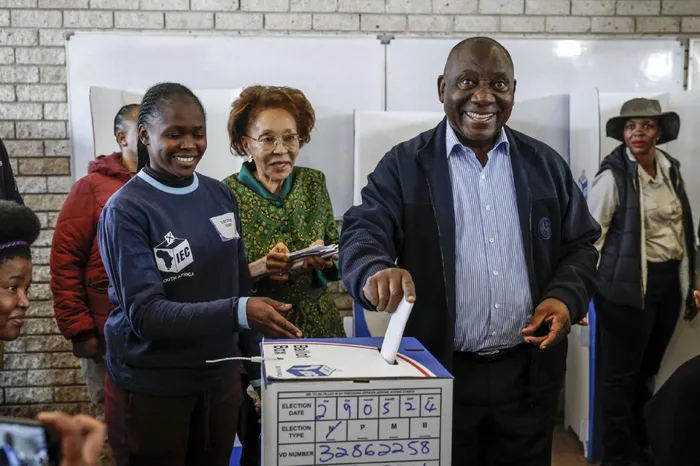
First Lady Tshepo Motsepe (centre) and President Cyril Ramaphosa casting their votes at the Hitekani Primary School polling station in Soweto on May 29, 2024, during South Africa’s national and provincial elections. The 2026 local government elections thus represent more than a routine electoral contest. The future of the country. will be determined as much by the decisions of its citizens as by those elected to govern, says the writer.
Image: AFP
Dr. Reneva Fourie
South Africa cannot afford another election defined by public indifference. The 2026 local government elections must become a national statement that public office exists to serve citizens rather than party and personal interests.
That objective depends on one principle above all others. Accountability. Without visible and consistent accountability across every sphere of government, public trust will continue to erode.
Young South Africans who have grown up surrounded by corruption scandals, allegations of abuse of power and slow-moving investigations will struggle to believe that voting can still shape the country's future if wrongdoers are not held to account.
The democratic optimism that defined 1994 was built on the conviction that every vote carried the power to change South Africa. The institutions of democracy commanded legitimacy because they inspired public confidence.
That confidence requires constant renewal through ethical leadership, transparent governance and equal application of the law. The shared responsibility to sustain that confidence rests with every elected representative, state institution, oversight body, civil society and citizens themselves.
President Cyril Ramaphosa assumed office promising a New Dawn after almost a decade of institutional decline and state capture. Important reforms have strengthened investigative capacity and restored elements of institutional stability.
However, outcomes rather than promises measure renewal. Renewal is demonstrated through enhanced public control, effective prosecutions, credible appointments, capable institutions, adequate resourcing and equality before the law.
Until these become the defining characteristics of public administration, many South Africans will continue to question whether meaningful renewal has taken place.
The conduct of the President is integral to any assessment of renewal. The Phala Phala matter remains under public scrutiny. The President has consistently maintained that he has done nothing unlawful. If he is confident in his innocence, every legitimate avenue of scrutiny should be allowed to reach its conclusion.
Public confidence depends upon complete transparency. Allegations involving the country's highest office cannot remain a recurring source of uncertainty. Comprehensive scrutiny serves both the public interest and the interests of any office bearer seeking to clear their name.
The same principle applies across the political spectrum. Allegations of misconduct are not confined to any one party. Democratic Alliance areas of governance have faced claims relating to procurement processes, including a forensic report into a R1.2 billion Western Cape information technology tender in which bid documents were misrepresented to favour a preferred company.
Former DA leader Tony Leon faces allegations that his firm, Resolve Communications, used political connections to influence DA ministers, lawmakers, and municipalities on behalf of clients. Political parties that seek public trust based on ethical governance must apply the same standards within their own organisations that they demand of their opponents.
Accountability in the judiciary is imperative. The prolonged special leave of Eastern Cape Judge President Selby Mbenenge illustrates why the justice system must resolve serious matters with greater urgency.
Mbenenge has remained on paid special leave for approximately three years while proceedings regarding a sexual harassment charge continue. Regardless of the eventual outcome, justice requires timely resolution.
Extended delays undermine confidence in judicial administration, create uncertainty for the institution concerned and raise legitimate questions about whether accountability is operating effectively.
The National Prosecuting Authority has presented further damaging examples. Former National Director of Public Prosecutions, Shamila Batohi, requested the Nkabinde Commission to examine Gauteng Director of Public Prosecutions Andrew Chauke's fitness for office.
She subsequently withdrew from the process after twice leaving her own cross-examination and declining to complete her evidence when the Commission ruled that her explanatory statement carried no evidentiary weight.
Such conduct weakens confidence in a process that depends upon credibility, transparency and accountability.
Recent developments at the Investigating Directorate Against Corruption (IDAC) have raised similar concerns. Considering Andrea Johnson's extensive experience, the errors revealed at the Madlanga Commission are difficult to explain.
The swift acceptance of her resignation, with full benefits, is also troubling. Her departure should not end scrutiny. Accountability requires transparency to determine whether misconduct, political interference or systemic failures occurred.
Accountability within the South African Police Service carries an even greater weighting because its constitutional purpose is to uphold and enforce the law. Allegations involving SAPS members have become a persistent feature of public life.
Every credible allegation of corruption, abuse of authority or criminal conduct requires swift, independent and transparent investigation and conviction. Professional police officers deserve institutions capable of removing those whose misconduct damages operational effectiveness and erodes public confidence.
The appointments now before government provide an opportunity to demonstrate that merit will prevail over political considerations. Provincial SAPS commissioners should be appointed solely based on professional competence, operational experience, and proven ethical leadership.
Political loyalty has no place in appointments to positions entrusted with enforcing the law. Likewise, the appointment of the next head of the Investigating Directorate Against Corruption carries equal importance.
South Africans deserve complete confidence that anti-corruption investigations will proceed without fear, favour, or political influence regardless of the office status, political affiliation or faction of those under investigation.
Civil society has previously demonstrated its capacity to compel accountability. The ‘Zuma must fall’ movement and organisations such as the Ahmed Kathrada Foundation showed the influence of organised public pressure in confronting abuses of power.
That momentum has diminished, and their voices have become comparatively restrained during the latest succession of revelations. Accountability depends upon sustained pressure from citizens, unions, faith communities and civic organisations prepared to defend constitutional principles irrespective of who is implicated.
The 2026 local government elections thus represent more than a routine electoral contest. The future of the country. will be determined as much by the decisions of its citizens as by those elected to govern.
Voters should consider the integrity, competence and track record of candidates, as well as their commitment to establishing municipalities that provide services with fairness, efficiency, accountability and respect for every community they serve.
Supporting leaders and parties dedicated to constitutional governance, ethical leadership, social and economic justice and accountable public administration, while strengthening South Africa's contribution to peace, cooperation, sustainable development and human dignity across Africa and the wider world, reinforces the foundations of democracy.
In this way, the promise of 1994 is honoured, helping to build a prosperous, inclusive and united South Africa that contributes to a better world, and the next generation is entrusted with a nation worthy of their confidence and aspirations.
* Dr Reneva Fourie is a policy analyst specialising in governance, development and security.
** The views expressed do not necessarily reflect the views of IOL or Independent Media.