Understanding the Impact of Opinion Polls on SA's Electoral Landscape
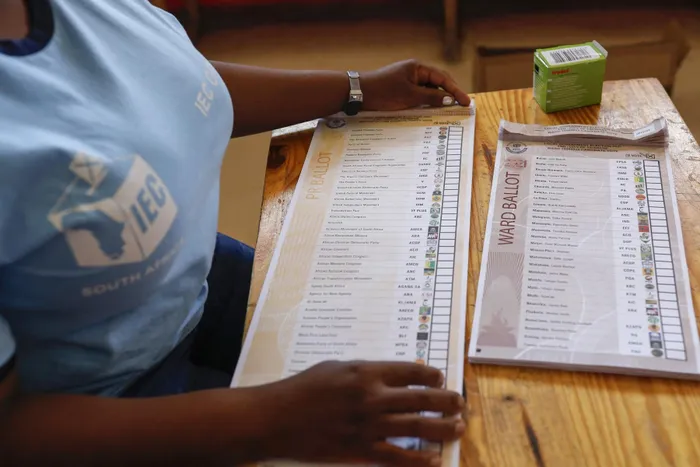
An electoral commission official prepares ballot papers at a polling station in Mabopane township, north of Pretoria, on November 1, 2021, during the last local elections.
Image: AFP
Prof. Bheki Mngomezulu
Opinion polls are a global phenomenon. Before an election, independent survey companies, media houses, political parties, and other role-players conduct surveys to predict the election outcomes. Lately, social media plays a critical role in this regard.
As Zambia prepared for the country’s election on Thursday, August 13, 2026, organisations like Zambia Election Research Network (ZERN) conducted opinion polls between June and November 2025.
The findings revealed that 41% of the participants felt that the country’s economy had worsened since the country’s last election. Only 38% felt that their personal lives had improved. Regarding the projected results, 55% supported the incumbent governing party, 13% preferred the opposition party, while 32% were undecided.
As Israel prepares for its 2026 election on October 27, various polling agencies have been making predictions about the country’s 14 political parties. They all agree that Benjamin Netanyahu’s Likud party will win by between 20% and 35%.
On November 3, 2026, America will hold its midterm election to establish whether the Republican Party still enjoys the majority in the Senate. Polls by Logan Phillips show that the Democratic Party stands a better chance with 57.6% as opposed to the Republican Party’s 42.4%. This translates to a 51.2% allocation of seats for the Democratic Party against 48.8% of the seats going to the Republican Party.
Each poll is accompanied by contributing factors. In the case of both Israel and America, the war in the Middle East is one such factor. Many voters in Israel support Netanyahu, who has been marketing his annihilation of communities in Palestine, Lebanon and Iran as a security strategy meant to protect the people of Israel.
By contrast, President Trump in America is losing popularity and support for various reasons. Firstly, the war he promised would be swift has dragged on for so long. Secondly, American interests abroad have been left vulnerable to several attacks, thus threatening the lives of American citizens working at American Embassies and companies.
Thirdly, more budget has been shifted to sustain the war. Fourthly, America’s global image has been dented. Fifthly, some feel that the war against Iran and the other two countries was unjustifiable since none of these countries posed an imminent threat to America’s security.
Given the synopsis presented above, South Africa cannot be insulated from this reality. Before each election – both the general election and Local Government Election (LGE) – various election opinion polls surface. The upcoming LGE on November 4, 2026, following the official gazette by Minister Hlabisa on August 7, 2026, has attracted various opinion poll surveys.
The Social Research Foundation (SRF) is one of many independent companies and media houses that have produced opinion polls about the upcoming election. Since this will be the LGE, most of the polls focus on specific provinces and metros.
Zooming into Johannesburg Metropolitan Municipality, SRF projected that the ANC’s support will decline while that of the DA will increase. Results for Quarter 1 of 2026 showed that the DA would obtain 39% of the votes while the ANC would only manage 30%. During Quarter 2, this trend was maintained as the DA was projected to obtain 42% while the ANC would be reduced to a mere 18%.
When looking at the city of Tshwane, both the SRF and The Common-Sense surveys concluded that the DA and Freedom Front Plus (FF+) could jointly govern Tshwane while other political parties were pushed to the opposition benches.
Parties like ActionSA, EFF, uMkhonto Wesizwe Party (MKP), and others would still be visible actors but with insignificant numbers.
In KwaZulu-Natal, especially in eThekwini Metropolitan Municipality, the scales were tilted in favour of the MKP. This was due to the popularity this party has enjoyed in KZN since it was formally announced on December 16, 2023. Its popularity was evidenced in the 2024 general election, where it obtained 37 seats in the KZN legislature – followed by the IFP with a mere 18 seats.
However, the polls show that the MKP’s support could be reduced from the 2024 figures.
The projected results tabled above should be understood in context. The ANC’s projected decline is credited to various factors. Most of them have to do with ‘sins of incumbency’.
Firstly, the president of the ANC – a party that is leading government – ascended to the presidency with a false notion that he was bringing with him what he called ‘the new dawn.’ This gave South Africans false hope that things were going to change for the better.
As the country’s unemployment rate and crime statistics surge, this hope has been dashed. The country’s economy has not improved. Factionalism within the ANC has negatively affected the country’s growth prospects. Recently, the issue of illegal immigrants has painted the ANC in a bad light.
Some accuse the ANC of its failure to contain the situation during the first six administrations. Others blame the ANC for failing to side with the masses when the country’s civic organisations took to the streets calling for illegal immigrants to be deported.
Although the DA seems to be gaining ground in Johannesburg and Tshwane, the fact that the party has become silent on many issues since forming part of the multiparty coalition government has led to some South Africans accusing it of being blinded by the blue lights and selling out South Africans.
As for the MKP, instability in the party is seen as its main downfall.
The EFF, which once enjoyed youth support, seems to have reached its end. Moreover, the unceremonious exit of leaders like Dr Mbuyiseni Ndlozi and Floyd Shivhambu dented the party’s image.
While these factors are real, voters must not be easily swayed by them. They should remain vigilant and critical as they interpret the results. For example, what was the motive for conducting each survey? Who conducted it? What was the sample size and its diversity? What are the advantages and disadvantages of conducting surveys? Importantly, to what extent do polls relate to voters’ lived experiences?
* Prof. Bheki Mngomezulu is Director of the Centre for the Advancement of Non-Racialism and Democracy at Nelson Mandela University.
** The views expressed do not necessarily reflect the views of Ithe National Media Group.